My shelves suggest I don’t need another wargame. My curiosity apparently didn’t get the memo. When the good folks at Cube4Me reached out and asked me to take a look at Okuniev 1944 from Zak Force Games, I figured it deserved a little reconnaissance. The subject caught my attention because it’s outside my usual rotation, and the promise of bluffing, deduction, and tense command decisions gave me another reason to dig deeper. I haven’t pushed any pieces across the map yet, but there’s enough here to make me want to pull up a chair. Let’s take a look at what caught my eye.
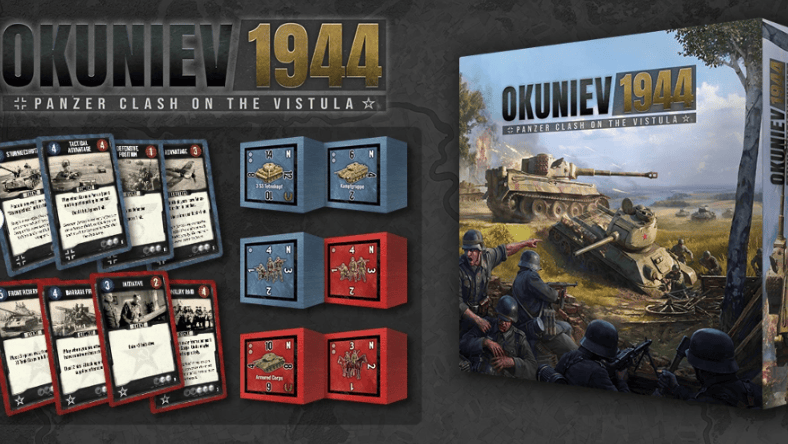
The hidden-order system is where Okuniev 1944 really starts to grab my attention. Orders are placed face down, leaving you to work out what your opponent has planned while keeping your own intentions under wraps. With different orders producing different outcomes, that move across the table could mean trouble, or it could be exactly what your opponent wants you to believe. I love the sound of that. Suddenly, I’m wondering whether I’ve spotted a weakness or been invited into a trap. If the system delivers on that promise, I can see plenty of second-guessing, suspicious looks, and “I knew you were going to do that” comments after someone clearly did not.
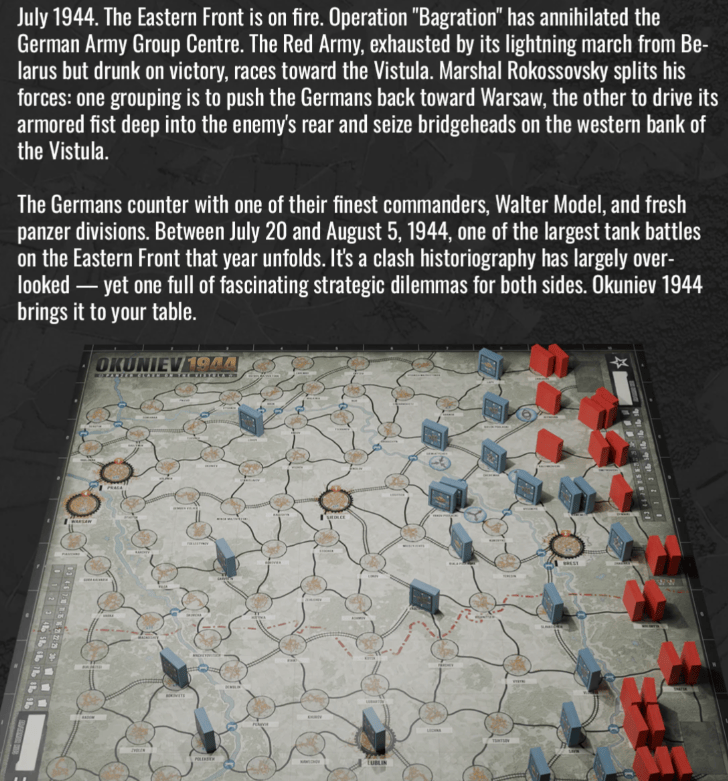
Of course, every wargamer eventually asks the important question: what’s in the box? Okuniev 1944 includes a board depicting the terrain between the Bug and Vistula rivers, wooden unit blocks that conceal their strength and type from your opponent, and a 55-card deck covering orders, historical events, combat modifiers, and reactions. Separate sets of order markers for the Red Army and German forces support all that bluffing, while a player aid and full rulebook help keep things moving. There are also four scenarios for two to four players, offering different difficulty levels and listed playing times of two to four hours. That scenario variety catches my attention, because I like having options when deciding how much battlefield trouble I can squeeze into an evening.
The one thing that gives me pause is how this will work for solo players. With hidden orders and reading your opponent playing such a big role, it doesn’t strike me as particularly solitaire-friendly, which could be a sticking point for those of us who often play alone. I’m curious to learn whether there’s a practical way to enjoy it solo without losing what makes the system interesting. For now, Okuniev 1944 has my attention. Stay tuned, because as I learn more, I’ll pass it along to you all.
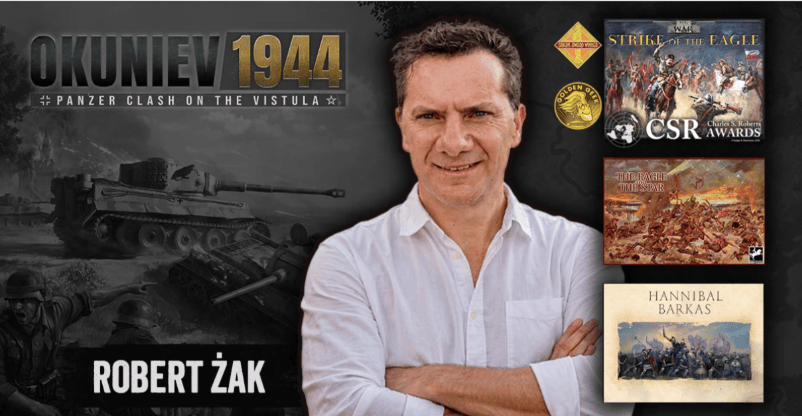
The designer behind Okuniev 1944 is Robert Żak, whose earlier work includes The Eagle and the Star. Academy Games later reworked that design into Strike of the Eagle, covering the Polish-Soviet War of 1920. According to the publisher’s project page, Strike of the Eagle earned the Best Historical Board Game award at the 2011 Origins Awards. That connection gives me another reason to be curious about Okuniev 1944, especially if you’re already a fan of Żak’s approach to command and hidden orders.



Leave a comment